Quick answer: Submersible well pumps fall under NEC Article 430's motor circuit rules, which govern wire sizing based on the pump's full-load amperage, breaker sizing to allow for startup inrush without nuisance tripping, and a disconnect requirement that works differently than most homeowners expect for a submersible motor. For the many Hesperia-area properties relying on private well water rather than municipal service, getting this wiring right affects both code compliance and your day-to-day water reliability.
Why Do So Many Hesperia Properties Rely on Well Water?
Rural and semi-rural zoning throughout Hesperia — including the larger-lot areas we've covered in our
horse property and barn electrical guide around Oak Hills and Summit Valley — often sits outside municipal water service entirely, making a private well the property's sole water source. That makes well pump reliability a genuinely different priority than it is for a typical suburban home connected to city water, since a pump failure here means no water at all, not just an inconvenience.
What's the Difference Between 2-Wire and 3-Wire Pumps, and Why Does It Change Your Wiring?
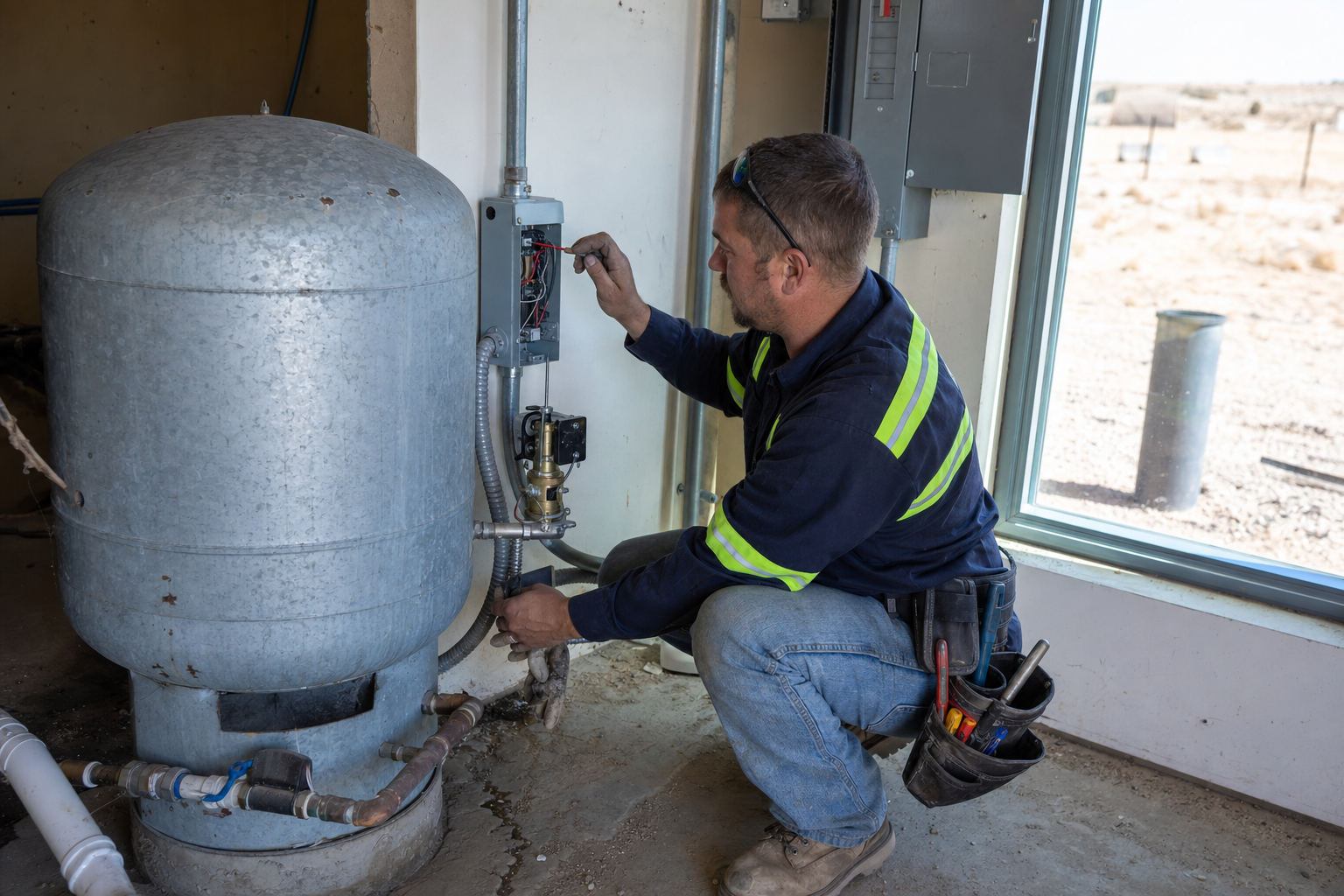
Most residential submersible pumps in the ½ to 1 horsepower range use a 2-wire configuration, with the motor's starting capacitor built directly into the pump itself — this means no separate control box is needed, just a straightforward path from panel to pressure switch to pump. Larger pumps, generally 1.5 horsepower and up, use a 3-wire configuration requiring a separate control box housing the starting components. Knowing which type your pump is (or will be) matters because it changes the wiring scope and parts list for the entire circuit, not just the pump connection itself.
How Is a Well Pump Circuit Actually Sized?
Under NEC 430.22, conductors serving a motor circuit need to be rated at a minimum of 125% of the motor's full-load amperage — a ½ HP pump might need only 14-gauge wire, while a 2-3 HP pump typically needs 10-gauge, and voltage drop becomes a real consideration on longer runs common on larger rural properties. Breaker sizing follows a different rule under NEC 430.52, allowing up to 250% of the motor's full-load amperage for inverse-time breakers specifically to accommodate the higher inrush current a motor draws on startup without causing nuisance trips — the same underlying principle we cover for
central AC circuits, where motor startup surge similarly requires different sizing rules than a standard branch circuit.
Where Does the Disconnect Actually Need to Be?
This is a detail that trips up a lot of DIY attempts. Under NEC 430.102, a disconnect is required within sight of the motor controller — but for a submersible pump sitting deep in a well casing, that requirement doesn't mean placing a disconnect at the wellhead itself. Since the pressure switch functions as the controller in most residential well setups, the disconnect requirement is satisfied by a switch located within sight of the pressure switch and pressure tank, typically inside a utility room or pump house, not out at the well itself.
Why Does Your Pressure Switch Need Surge Protection?
This is worth building into a well pump installation from the start rather than adding as an afterthought. A transient voltage surge suppressor installed at the pressure switch or main disconnect protects the pump's control components from grid-switching events and voltage spikes — a real and recurring risk in the High Desert given how often the region sees outages and grid activity. This pairs directly with the broader protection we cover in our
whole-home surge protection guide; a well pump on a property without whole-house surge protection is exactly the kind of critical, expensive-to-replace equipment worth protecting specifically, even if the rest of the home isn't yet covered.
What Happens If a Well Pump Circuit Is Undersized?
An undersized circuit can cause nuisance breaker tripping during pump startup, voltage drop that shortens motor life over time, or in worse cases, overheating in the wiring itself. For a property entirely dependent on this pump for water, a wiring problem isn't just an inconvenience — it's a real risk of losing water access until it's diagnosed and fixed, which is exactly why proper sizing from the start matters more here than it would on a municipal-water property with less riding on a single circuit.
What Does Well Pump Electrical Work Cost in Hesperia?
- New dedicated well pump circuit (2-wire pump, standard run): $500–$1,000
- 3-wire pump circuit with control box wiring: $800–$1,500
- Disconnect and pressure switch assembly installation: $200–$400
- Surge protection addition at the pressure switch: $150–$300
- Full well pump electrical troubleshooting and repair: quoted after diagnosis
FAQ
What size wire do I need for my well pump circuit?
It depends on the pump's horsepower — typically 14-gauge for a ½ HP pump up to 10-gauge for 2-3 HP pumps, sized to at least 125% of the motor's full-load amperage per NEC 430.22.
Does a well pump disconnect need to be located at the well itself?
No. Since the pressure switch functions as the motor controller in most residential setups, the required disconnect needs to be within sight of the pressure switch and pressure tank, not the submersible pump in the well casing.
What's the difference between a 2-wire and 3-wire well pump?
2-wire pumps have the starting capacitor built into the motor and need no separate control box, common for ½-1 HP pumps. 3-wire pumps require a separate control box, typically for pumps 1.5 HP and larger.
Does a well pump need surge protection?
It's strongly recommended. A transient voltage surge suppressor at the pressure switch protects the pump's control components from grid-switching events, which are a real risk given how often the High Desert experiences outages.
What happens if my well pump circuit is undersized?
It can cause nuisance breaker tripping, voltage drop that shortens motor life, or overheating in the wiring, all of which risk losing water access on a property entirely dependent on the well.
Rely on well water at your Hesperia property?
Get your pump circuit properly sized and protected.
Call Hesperia Electrical at (760) 905-9997 for a free assessment.